The problem
Story-based games are great at getting students engaged, but engagement alone doesn't guarantee that students gather evidence, weigh it, and build a sound argument. AI agents could provide that support, yet little is known about how students actually respond to them in real classrooms, or whether they deepen thinking or just shortcut it.
How SciStory works
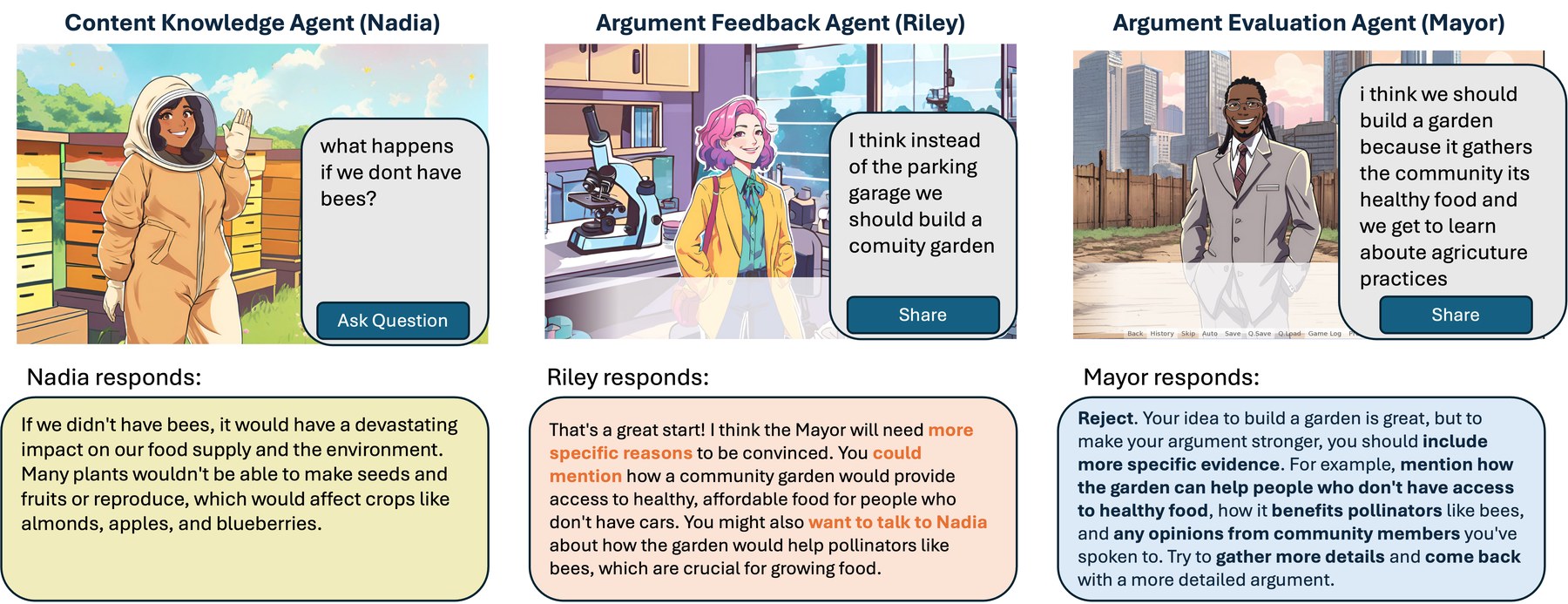
Students explore an illustrated town, talk with more than ten characters, take notes in a digital notebook, and draft an argument for the Mayor. The ending changes depending on whether they convince the Mayor. Each AI character has a distinct teaching role tied to one phase of scientific inquiry:
- Content knowledge agents (such as Nadia, the beekeeper) answer open-ended questions about pollinators and food systems.
- Argument feedback agents (such as Riley) coach students to strengthen claims and add evidence.
- The Mayor evaluates the final argument, and that judgment shapes the story's ending.
See it in action
What I did
- Led a classroom study in Nashville in April 2026 with 73 sixth graders using GPT-4o agents, collecting game logs, surveys, and audio and screen recordings of student pairs.
- Analyzed the 2025 pilot run by our partner team (15 student pairs, locally hosted Llama-3.1-8B). I turned raw game logs into coded inquiry phases and used Markov models and sequence mining to see how each agent shaped students' inquiry.
- Now leading a multimodal analysis of audio and screen recordings to capture peer discussion and reasoning that agent logs alone don't show.
What I found
Each AI character pulled students into a different part of the inquiry cycle. The knowledge agent kept students gathering evidence, the feedback agent prompted repeated rounds of sharing and revising arguments, and the Mayor moved them toward reflection and conclusions.
There was also a caution: in 78% of conversations with the knowledge agent, students looped through investigation without moving on to build an argument. Agents need to be coordinated so students don't stay stuck in information gathering.
In the 2026 classroom study, students responded positively to the AI characters:
Why it matters
Counting how often students talk to an AI agent says little about learning. This work shows how to measure what agents actually do to students' reasoning, and it offers practical guidance for deploying LLMs in schools responsibly, including comparing a privacy-preserving open-source model with a commercial one across two classroom studies.
Publications
- SciStory: An AI-powered narrative-centered learning environment for scientific inquiry. AIED 2026, demo
- The role of LLM-powered conversational agents in supporting inquiry in a narrative-centered learning environment: A learning analytics study. LAK 2026, co-first author
- A theory of adaptive scaffolding for LLM-based pedagogical agents. AAAI 2025, related work